
Home Blog Page 71

Unveiling Solar Superstorms: Energy and Impact on Earth

0

Introduction:

Solar superstorms, sometimes called solar storms or space weather events, are extremely strong solar disturbances that can greatly impact Earth’s technological infrastructure. Strong energy eruptions known as solar flares and coronal mass ejections (CMEs) are released during these storms. These events can affect our planet’s magnetosphere and cause disruptions to various technologies. Comprehending the characteristics of solar superstorms is essential in formulating tactics to alleviate their possible consequences.

Sun Superstorm Elements:

1. Solar Flares: 

Solar flares are sudden, intense bursts of energy that radiate electromagnetic radiation anywhere from radio waves to X-rays from the sun’s surface. Depending on how much energy they produce, these eruptions can be divided into several groups, from weak C-class flares to strong X-class flares.

2. Coronal Mass Ejections (CMEs):

Coronal mass ejections, or CMEs, are large-scale outbursts of solar wind and magnetic fields that rise above the solar corona or are ejected into space. When these charged particles come into contact with the Earth’s magnetic field, they can cause geomagnetic storms.

Impacts on Earth:

1. Power Grids: 

The Earth’s magnetic field protects us from the damaging effects of solar radiation. On the other hand, the heightened solar activity during a solar superstorm can cause strong electrical currents to arise in the Earth’s atmosphere. These currents can enter electrical networks, resulting in voltage instability and widespread blackouts in the worst situations.

2. Satellite Communication and Navigation: 

Radio signal interference caused by solar storms can impact systems that rely on satellite communication and navigation. This disruption could impact numerous industries, such as global positioning systems (GPS), aviation, and maritime navigation.

3. Auroras: 

Solar superstorms improve the aurora near the polar areas, although they do not pose a direct hazard. Although striking to look at, the enhanced geomagnetic activity may have an impact on local radio communications and navigation systems.

Preparedness and Mitigation:

1. Early Warning Systems:

Predicting possible solar superstorms requires tracking the sun’s activities. Cutting-edge space weather forecasting systems can issue early alerts, enabling the taking of preventative action.

2. Reinforcement of Infrastructure:

One of the most important things to do is to fortify communication and electricity grids against solar storm damage. Installing gadgets that instantly disconnect delicate components during geomagnetic storms can prevent widespread damage.

3. Working Together Internationally:

International cooperation is essential for exchanging information, research, and resources because solar superstorms exist worldwide. More reliable monitoring systems and well-coordinated reactions to possible threats can result from collaborative efforts.

Conclusion:

Solar superstorms are an interesting and potentially disruptive feature of our sun’s behaviour. We must comprehend and prepare for the effects of these solar occurrences as our reliance on technology grows. Research, technology, and international cooperation can lessen the risks associated with solar superstorms and make our increasingly interconnected world more robust.

Arthur Eddington: Pioneering Astrophysicist and Relativity Advocate

0

Introduction:

Sir Arthur Eddington (1882-1944) was trained in the three disciplines I have studied: Mathematics, Physics and Astronomy. I have, of course, taken detours in my studies, but I have always remained faithful to this trinity of subjects whilst becoming a student of all the Sciences.

Nuclear Fusion of Hydrogen into Helium:

Scholars claim that Arthur explained the energy-creating process within stars before any of his peers (i.e., the nuclear fusion of hydrogen into helium). Arthur was said to be Einstein’s Champion, and staying with Albert, Arthur was one of the first to demonstrate comprehension of Einstein’s theories on relativity. Others who showed such abilities include Max Born (1882-1970) and Hermann Minkowski (1864-1909). Of course, since then, many generations of scientists have advanced Albert’s ideas, perhaps none more so than Sir Roger Penrose (1931-), who I recently heard about during an online course in August 2021 at the University of Arizona (I to add that Roger was an undergraduate at UCL so every day I can walk in the footsteps of a “Giant”).

General Theory of Relativity:

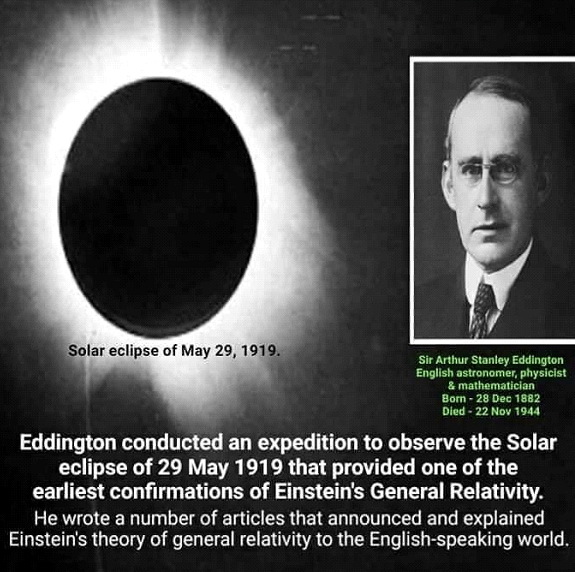
Arthur was appointed Astronomer Royal and is linked to the event that toppled Newton’s gravitational theory. Arthur, who became Astronomer Royal, was involved in toppling Newton’s theory of gravity. Later, Einstein’s theory of gravity—which we now refer to as the General Theory of Relativity—replaced Isaac’s hypothesis. Thus, what did Arthur do? During a solar eclipse, Arthur measured the position of stars and compared their locations before the eclipse.

Einstein’s and Newton’s Theories:

According to the theories proposed by Einstein and Newton, this light would experience a bending effect. The stars would appear at a slightly different location. The presence of a big object causes this location discrepancy. In this example, our sun can distort light. Albert’s calculations were more accurate than Isaac’s in predicting the bending or angle of an arc. Therefore, during the solar eclipse on 29 May 1919 (just after the 1st world war with Germany), Arthur was responsible for the toppling of Newton’s theory, which had sat on the high table of Physics since 1687 and made room for the hypothesis of a German-born Jew.

One of Arthur’s most famous quotes is:

“The law that entropy always increases holds, I think, the supreme position among the laws of Nature. If someone points out to you that your pet theory of the universe disagrees with Maxwell’s equations – then so much the worse for Maxwell’s equations if it is found to be contradicted by observation – well, these experimentalists do bungle things sometimes. But if your theory is against the Second Law of Thermodynamics, then I can give you no hope; there is nothing for it but to collapse in deepest humiliation.”  

Conclusion:

Sir Arthur Eddington made groundbreaking contributions to astronomy, supported Einstein’s theories, and excelled at explaining difficult concepts, cementing his reputation as a pivotal scientific figure.

Johannes Kepler: The Unheralded Giant of the Scientific Revolution

0

The Scientific Revolution

Well, it’s time to pay homage to one of the unheralded “Giants” of the Scientific Revolution, Johannes Kepler (1571-1630). Kepler gave Physics his three planetary laws of motion, two of which (the ellipse and the T-squared laws) enabled I. Newton (1643-1727) to formulate his inverse law of the force of gravity that has stood has served us so well even after 1915 when Einstein usurped this law with his field equation based on his geometric intuition and interpretation of space-time.

Remaining with Newton’s inverse square law for a moment, I once read R.Feynman’s (1918-1988) lost lecture and in it Richard states from the outset that he will prove the inverse square law by using only what Newton had at his disposal, (Kepler’s laws of motion and an understanding of the conic sections inherited from the work of the Greek “Giants” of antiquity, in particular, Menaechmus studying their properties around 360-350 B.C), this book is an amazing read.

One feels like one is being lectured by Newton himself, and one eventually sees the great equation unravelling itself, becoming arguably one of the most famous laws in all of Physics and bringing about the demise of Hellenistic interpretations of the cosmos.

Debates of Scientific Pioneers

Kepler was a contemporary of Galileo (1564-642) who should be credited with what we call today Newton’s first law of motion (his inertial law) and conducted several experiments (the famous cannonball experiment from the Leaning Tower of Pizza), which was probably apocryphal along with the experiment (alleged event) of when Archimedes (287-212BC) used his curved mirrors to burn the invading Roman armada, and I state that this was alleged as scientists have tried to reproduce his results without success, this statement now reminds me of the debatable results of the father of heredity G.Mendel (1822-1884) as his results were statistically examined and have been shown to be too precise with scholars suggesting that he “cooked the books” to accomplish them.

The Impact of Astronomy

Returning to Kepler, he earned a good living calculating horoscopes, and one should remember that astrology was not entirely disparate from astronomy during this period. Remaining with the coupling of disciplines and the role of Astronomy, it is well known that the three disciplines that have influenced the development of Mathematics through the ages include astronomy (man’s need to understand the cosmos and periodic motion so that he could accurately measure time so that harvesting could take place), commerce (man’s need to barter) and the most regrettable of all which is still just as prevalent today is war (with the greatest Mathematical and Scientific minds always being used by the military to produce more horrendous devices of mass destruction (e.g. J. Lagrange (1786-1813) accompanied N.Bonaparte on his expeditions, Einstein’s (1879-1955) energy equation is used to develop and nuclear bomb (against his wishes of course).

Alas, once again, space (but not time) has got the better of me.

Mortgages and the Society: Are they any good?

“Mortgage Market refers to a conceptual construct where individuals, groups of individuals, and businesses source the money for their residential and commercial property needs”, says Campbell (2012, p 1). Therefore, the impact of mortgages on our society is profound. On one side, they enable social mobility by allowing people to become homeowners. Conversely, they create economic activity through spending on renovations, extensions, decoration, and construction. Therefore, increased activity in the mortgage market is bound to translate into increased activity in other sectors of the economy.

Mortgage a Common Man Financial Instrument Unlike bonds and stocks, mortgages are personal financial instruments. These instruments are part and parcel of our contemporary lifestyle as they enable individuals, families, and businesses to buy real estate to meet their housing and office needs. However, the question is that in doing they only generate positive externalities, or they also generate negative externalities.

Mortgage Markets’ Positive implications on the society

The mortgage market enables a society in several ways. From helping people move onto the property ladder to increasing the wealth of nations. All these impacts are profound. However, a few concrete impacts of mortgage markets are as follows:

  1. Help strengthen the local communities and house prices: When people choose to mortgage their homes in a particular area, it directly affects the prices of houses, business activity, and development of that area.
    1. Firstly, the increased availability of mortgages means that there’s a higher demand for houses. As a result, the value of the existing stock of assets goes up.
    1. Secondly, a new homebuyer generally spends considerable money on renovation and refurbishment of the house. Therefore, higher mortgage numbers mean people will spend money in the local community and help the local community to grow.
  2. Increase social mobility: The ability of first-time buyers and less wealthy clients to get onto the property ladder strictly depends on the ease with which mortgages are available.
  3. Improved Housing Quality: Increased home ownership due to mortgages ensures homeowners look after their houses. They are likely to spend on their maintenance and upgrade of the houses. This also results in increasing the energy efficiency of the house. However, the trend may be reversed during the economic downturn. As homeowners realise that banks may repurpose their houses, this could lower the efforts on maintaining the house.
  4. Development of the Society by limiting the people’s ability to shift houses from one place to another. As mortgage holder become tied to their property, therefore, they would rather stay in the same place for longer. This helps a country to build local communities and promote social bonding.
  5. The flow of capital from surplus agents to deficit agents enables banks to offer mortgages to people who do not have cash to buy a house.

Risks and Negative Implications of Mortgages:

Like other financial assets and markets, the mortgage market also has severe risks to the financial system and society.

  1. Financial Crisis: As increased mortgage activity means rising housing prices, house prices may be inflated. This inflation eventually leads to a point where new buyers may end up paying exorbitant prices for the house. Therefore, when they borrow against the property, they must borrow huge sums and pay high interest on the principal amount. As a result, the risk of default increases. Imagine if 33% of your income is spent on a mortgage, then a slight reduction in your income may make default more likely.
  2. Real Estate Bubbles: Increased activity in the mortgage activity means higher demand for the existing housing stocks. It also attracts the attention of speculators who want to get on the tide and make quick money. Therefore, people backed by purchasing power through loans offer higher and higher prices for the same asset. This entire activity results in a real estate pricing bubble and ultimately leads to large market corrections.
  3. Volatility in Housing Prices: Similarly, when banks reduce the number of approved mortgage applications, it affects the house prices negatively. A decrease in the mortgage application approvals means that now there is a reduced demand (prospective buyers) in the market. This means that existing homeowners must lower the price to sell their houses. Therefore, mortgage markets play a great role in the ups and downs in the prices of houses and affect our personal portfolios.
  4. Risk Aggressive Banking:  Banks are incentivised to issue mortgages to more and more people to earn a commission. Therefore, banks may lend money to people whose ability to pay back needs to be improved.
  5. Consumer-oriented society: Another negative impact of mortgages is that they encourage consumerism and promote a society where individuals do not save enough.
  6. Complex Securitisation: Banks employ financial engineering techniques to construct Mortgage-backed Securities (MBS). These securities go through a complex structuring process where assets with credit quality are combined to create tradeable financial instruments. These instruments are further sold to financial investors across the world. Therefore, mortgage holders’ performance (i.e., if they continue to pay on time and in full) results in an income stream for investors in faraway countries. Although this enables banks to generate higher income and distribute their risk across the market, nevertheless, it also creates systemic risk for financial markets and systems.
  7. Default and Contagion: Complex securitisation distributes the default risk of counterparties system-wide and worldwide. Therefore, the performance of borrowers in one country determines the performance of portfolio holders in the other country. As a result, the entire financial markets become connected, and as one party defaults, it leads to the default of other parties.

References

  1. Campbell, J. Y. (2013). Mortgage market design. Review of Finance, 17(1), 1-33.
  2. Adelino, M., Schoar, A., & Severino, F. (2018). The role of housing and mortgage markets in the financial crisis. Annual Review of Financial Economics, 10, 25-41.
  3. Chomsisengphet, S., & Pennington-Cross, A. (2006). The evolution of the subprime mortgage market. Federal Reserve Bank of St. Louis Review.
  4. Cook, N., Smith, S. J., & Searle, B. A. (2009). Mortgage markets and cultures of consumption. Consumption, Markets and Culture, 12(2), 133-154.
  5. Aalbers, M. B. (2016). The financialisation of home and the mortgage market crisis. In The financialisation of housing (pp. 40-63). Routledge.

The Mortgage Market: Supporting Homes, Entrepreneurs and Firms

In developed economies, a typical household has three dominant assets in its wealth portfolio: Cash, a Car, and a house. Interestingly, apart from the first, the latter two are usually financed real-asset purchases, which means the households do not enjoy the ultimate title to it. Nevertheless, they utilise them as any normal owner of the asset would do so. The Mortgage Market enables households to get on the property ladder. It helps businesses and firms get the necessary financing for buying buildings and other land assets to expand their business operations.

Relationship Between the Mortgage Market and the Economy Mortgage Market activity is highly dependent on the interest rate set by the central banks and the general demand level in the country. For example, as of Q2-2023, the UK outstanding mortgage debt is £1,655.5Bn. Which is approximately £9.375Bn less than the expected amount. The biggest ever drop since 2007. This drop is due to an increase in interest rates from almost 0.25% to 5.25% and an increase in inflation. That has ultimately resulted in customers applying for mortgages and banks being more careful when granting loan applications.

Mortgage Market as a Complex System

Mortgage Market refers to a conceptual construct where individuals, groups of individuals, and businesses source the money for their residential and commercial property needs. Ostensibly, it’s assumed that a mortgage is a bilateral agreement between a mortgage and the bank, and the property is pledged as collateral. Nonetheless, technically, it’s a flawed understanding of the entire process. Banks or other financial intermediaries purchase the IOU written by the mortgage holder. This IOU is a debt security that banks re-sell to the investors and then act as a middleman between the investors and mortgage holders. Banks collect cash (monthly mortgage payments), deduct their collection fees, and pay the remainder to the investors.

Therefore, the Mortgage Market is a complex system in which mortgage holders, financial institutions, and investors are tied to one rope. Therefore, the performance of one party affects the performance of the other party. For example, if the mortgage holders make payments on time and clear their debt, then the banks also can collect the cash and disburse it to the investor of Mortgage-Backed Securities. However, the default of one party leads to the default of the other two parties as well, subprime crisis is a good example to understand this phenomenon.

Understanding a Mortgage Agreement

A mortgage is a long-term loan secured by real estate (house or offices. Individuals, businesses, or governments can obtain long-term secured loans in the mortgage market.

Therefore, the instruments created by this are as follows:

  1. IOU notes by the mortgage holder, the person mortgaging a house. This note is a debt obligation like a bond and carries a fixed interest, maturity date, and frequency in which payments are to be made.
  2. The second instrument is a Mortgage-Backed security (MBS). This is resold to investors over the counter or through a trade exchange.
Securitisation of Mortgage Agreement In capital markets, the instruments exchanged are usually standard and pre-issued by issuers such as firms, governments, and corporations. However, the mortgage market instruments are created to meet the needs of individual customers. Therefore, when the MBSs are created, they are also heavily customised to meet the needs of investors. This process is known as securitisation. Securitisation refers to the process whereby multiples (e.g., 1000s of) individual mortgages are bundled together and sold as security to the investors. This allows the originator of mortgage loans to transfer risk from their books to another investor. It also frees capital for the bank to make loans for new investors and enables them to continue helping people buy houses.

References

  1. Campbell, J. Y. (2013). Mortgage market design. Review of finance, 17(1), 1-33.
  2. Adelino, M., Schoar, A., & Severino, F. (2018). The role of housing and mortgage markets in the financial crisis. Annual Review of Financial Economics, 10, 25-41.
  3. Chomsisengphet, S., & Pennington-Cross, A. (2006). The evolution of the subprime mortgage market. Federal Reserve Bank of St. Louis Review.
  4. Cook, N., Smith, S. J., & Searle, B. A. (2009). Mortgage markets and cultures of consumption. Consumption, Markets and Culture, 12(2), 133-154.
  5. Aalbers, M. B. (2016). The financialization of home and the mortgage market crisis. In The financialization of housing (pp. 40-63). Routledge.

Insurtech in FinTech: Innovations in the Insurance Industry

Introduction:

The insurance sector, which was once considered conservative and hesitant to embrace change, has undergone a dramatic metamorphosis in recent years. The sector has witnessed a surge in innovation because of the advent of new hazards, rapid advancements in technology, and changing client expectations. This article examines some of the most significant developments in the insurance sector and how they affect risk evaluation, management, and mitigation.

Insurtech Startups:

One of the biggest factors changing the insurance industry is the emergence of insurance businesses. These innovative businesses use cutting-edge technology like blockchain, data analytics, and artificial intelligence to improve customer experience, expedite workflows, and develop new insurance offerings.

a. Artificial Intelligence (AI) and Machine Learning:

By processing enormous volumes of data, AI-powered algorithms help insurers identify fraudulent claims, make more accurate underwriting decisions, and customize offers based on the unique profiles of their customers.

b. Blockchain Technology:

Insurance transactions are becoming more efficient, transparent, and secure thanks to the decentralized ledger system of blockchain technology. Blockchain-powered smart contracts allow for automated claims processing, which lowers administrative expenses and boosts policyholder and insurer confidence.

c. Telematics and IoT:

Insurance companies can track real-time data on driving habits, health, and property conditions by integrating telematics and Internet of Things (IoT) devices. This data encourages safer behaviour and more precise premium calculation by providing usage-based insurance plans.

Data Analytics and Predictive Modeling:

Advanced data analytics approaches revolutionize how insurers evaluate risk and determine prices. Insurance companies may improve their underwriting procedures, produce more precise risk assessments, and customize coverage alternatives using big data and predictive modelling.

a. Predictive Analytics:

Insurers may estimate future patterns using statistical algorithms and historical data and more efficiently anticipate and reduce risks. This strategy is especially helpful regarding risks associated with climate change and health insurance.

b. Client Profiling:

With insurers’ increased access to client data, they can provide more individualized services and customized plans that cater to individual requirements and preferences.

Parametric Insurance:

In place of traditional loss assessment, parametric insurance is a cutting-edge method of risk management that provides predetermined payouts depending on particular, measurable characteristics (such as weather, seismic activity, or other quantifiable events).

a. Quick Payouts:

Because parametric insurance policies pay out automatically when conditions are met, they frequently result in quicker claims settlements than traditional insurance.

b. Natural Disaster Coverage:

This type of insurance is very helpful in offering quick financial assistance to people and companies impacted by natural catastrophes like floods, earthquakes, and hurricanes.

Cybersecurity and Cyber Insurance:

Specialized cyber insurance policies have emerged as a result of the frequency and sophistication of cyberattacks increasing. These regulations lessen the financial toll ransomware attacks, data breaches and other cyber threats take on individuals and companies.

a. Risk Assessment and Mitigation:

To lessen the chance of a breach, insurers provide policyholders with services and tools to assist them in finding vulnerabilities and putting cybersecurity safeguards in place.

b. Incident Response:

Cyber insurance plans frequently find incident response and recovery clauses. These clauses cover expenses for public relations campaigns, impacted parties’ notices, and legal expenditures.

Conclusion:

Technology breakthroughs and shifting customer expectations are causing a significant transformation in the insurance sector. These advancements alter risk assessment, management, and minimization, ultimately leading to more responsive, individualized, and efficient insurance solutions. Keeping up with these changes will be essential for insurers, policyholders, and other stakeholders as the market develops.

Competitive Programming with HackerRank: Strategies for Success

Introduction:

The HackerRank platform has changed how programmers and developers review their coding knowledge and prepare for technical interviews. Vivek Ravisankar and Hari Karunanidhi founded the forum in 2009, and since then, it has developed into one of the most well-known coding challenge and evaluation platforms worldwide. With more than 180 nations represented among its user base and an extensive collection of coding challenges, HackerRank has become a vital resource for novice and seasoned coders.

The Platform:

Numerous coding challenges in various areas, such as databases, artificial intelligence, data structures, algorithms, and more, are available on HackerRank. With the help of these exercises, developers should solve issues more skillfully and practically learn new concepts. Users can ensure they can code in their preferred language by selecting a wide range of programming languages. HackerRank offers businesses a strong platform for technical interviews and evaluations. Employers can analyse candidates’ technical skills with custom coding assessments, which helps them make well-informed recruiting decisions. HackerRank is used by big giants like Goldman Sachs, Amazon, and Airbnb for their technical hiring procedures, demonstrating the considerable popularity this technique has achieved in the sector.

Learning and Community:

The lively and engaged community on HackerRank is one of its main advantages. Users can work together on tasks, participate in code contests, and discuss coding issues in forums. Thanks to this community-driven approach, developers of various skill levels may learn from, work with, and network with each other. In addition, HackerRank provides targeted courses and tutorials for different topics and skill levels. By offering defined learning routes, these tools help users become experts in particular technology or ideas.

Inclusivity and Accessibility:

One major contributing aspect to HackerRank’s popularity is its accessibility. Individuals can utilise the portal, which offers free coding challenges and educational materials. Thanks to this open access, people from all walks of life can now access technical learning.

HackerRank and Tech Sector:

Additionally, HackerRank actively supports diversity and inclusivity in the tech sector. Through programmes like “Pride in Tech” and “Women Who Code,” the platform supports marginalised groups and cultivates a more equitable and inclusive tech community.

Creativity and Development:

  • HackerRank’s continued innovation and development are responsible for its success. The platform frequently rolls out new features and updates to enhance user experience.
  • The launch of the “Interview Preparation Kit” and “Project-Based Learning” modules, for instance, has improved users’ learning experiences even more.

Towards Future:

HackerRank is in a strong position to significantly impact how technical education and hiring are developed in the future as the tech sector grows. Its dedication to offering affordable and efficient coding instruction and its robust community and business relationships guarantee that it will continue to be a mainstay in software development and programming.

Conclusion:

In the field of technical education and assessment, HackerRank has become a dominant force. With its platform enabling developers to study, practise, and become proficient coders, it has become a vital component of the worldwide technology industry. For many years to come, HackerRank’s creative methodology and unwavering dedication to diversity will undoubtedly shape the way we approach technical hiring and coding.

Joseph Henry: Illuminating the Path of Electromagnetic Research

0

Introduction:

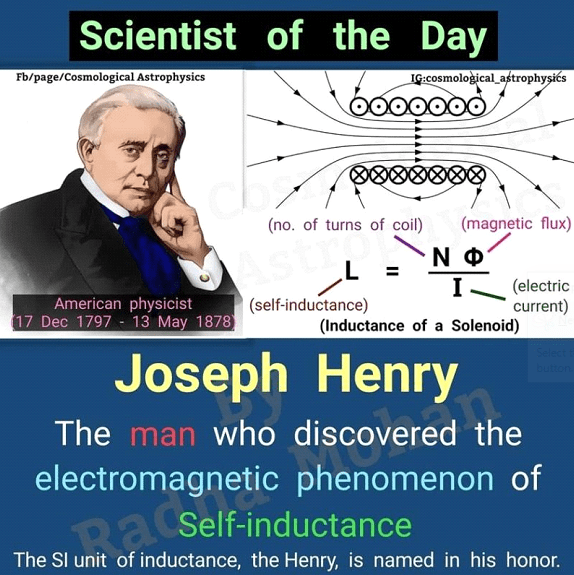
American scientist Joseph Henry, born in Albany, New York, on December 17, 1797, was a key figure in the 19th-century advancement of electromagnetism. Henry made just as much of an impact on the pitch as his contemporaries James Clerk Maxwell and Michael Faraday, although frequently being overlooked. This article explores the life and achievements of Joseph Henry, emphasising his groundbreaking contributions to the field of electromagnetic.

Early Life and Education:

Joseph Henry (1797-1878) elucidated the Scientific world on the concept of electromagnetic induction, that of inducing a current to flow when flux lines (of a magnetic field) are broken ‘cut’. It aided another of my “good friends”, Michael Faraday (1791-1867), to develop his law that Electromotive Force equals the rate of change of Magnetic Flux. It is quite a stretch to credit Michael with the Mathematical description of this law (as he was not the greatest Mathematician), which uses a well-known integral theorem.

Pioneering Contributions to Electromagnetism:

The teenaged “Giant” James Clerk Maxwell (1831–1879), a senior wrestler at Trinity College in Cambridge, accomplished this feat. He is now well-known for his four basic (and exquisite) equations, which, among other things, summarised all of the laws of classical electromagnetism. Maxwell himself presented 20 equations originally, but Heaviside reduced them to four. As a side note, starting with electromagnetism, Einstein (1879-1955) was a huge fan of Maxwell as he used his theory of relativity to account for magnetism caused due to the motion of electrons. I have this book in my library entitled “A Treatise on Electricity and Magnetism” by J.C. Maxwell. Another was the text by L. Boltzmann (1844-1906), but their discussions are for another day.

Thomas Jefferson:

Going back to Henry, he was honoured when the first Library of Congress building started in 1897. Unfortunately, though, the United States would rather keep the accomplishments of a statesman and president than a man of science. Therefore, it is now known as the Thomas Jefferson Building.

Conclusion:

I’m using the words from the Back to the Future trilogy. George is buried in Oak Park Cemetery in this fantastic television show to convey my age familiarity with the material. Oak Hill Cemetery is home to Joseph Henry’s grave. Did the filmmakers and producers honour the legendary man? Just a remark, but that might be a good idea. His inventive discoveries and creations enabled a great deal of technological advancement, showing the impact on the current electromagnetic research. Joseph Henry is not as well-known as some of his contemporaries. However, his contributions to the electromagnetic field are still significant and inspirational.

Overview of the IFRS Sustainability Standards: IFRS S1 and S2

Introduction

One of the most important and widely used concepts is that around sustainability. If you are wondering how this can be related to the business world, then a good starting point is to look at the new International Financial Reporting Standards (IFRS) on sustainability – IFRS S1 and IFRS S2. The aim of this article is to explain the frameworks within the standards that inform how they operate. The focus in the article is of the main principles forming the frameworks for the standards. The details of the standards can be found at the IFRS website. This article should, therefore, provide a clearer understanding of how sustainability is viewed by business leaders.

The IFRS are the global body that has developed and curated the IFRS standards – the standards which many countries across the globe use to guide financial statement creation. From 2021, the IFRS held several consultation exercises from which the need and details of sustainability standards emerged and were finally issued in June 2023.

There are two standards, and so we will look at them separately. Both standards are for reporting periods after 1 January 2024.

IFRS S1 – General requirements for disclosure of sustainability-related financial information

This standard provides the initial building block for sustainability standards and reporting and provides general guidance and rules.

The main aim of the standard is to require firms to disclose any risks and opportunities that financial statement users should know about. This is explained as anything from the ‘value chain’ that could specifically affect the cash flow over time. The value chain is used here to show the connection between all firm stakeholders, including the natural environment. As the data is likely to be more qualitative to help guide the information creation to be of use to stakeholders, all risks and opportunities that can be reasonably predicted must be included and should be comparable, verifiable, timely and understandable. The standard is intended to support stakeholders in understanding the most significant (material) risks and opportunities.

Disclosure around sustainability risks and opportunities should refer to changes around governance, strategies, risk management and metrics and targets. Much of the reporting has been connected to the financial statements – so the location and timing will be the same as those used in terms of the firm’s financial disclosures.

IFRS S2 – Climate-related disclosure

The aim of this standard is, in addition to IFRS S1, it provide specific guidance on climate risk disclosure. The standard directs firms to disclose any specific climate disclosure risk or opportunity that could affect the firms cash flow over time. This is to provide information to stakeholders in making decisions around the firm’s financial disclosures and their resources (investments) in the firm. The climate risks are split into physical risk and transition risk.

Like IFRS S1, the IFRS S2 standard is structured around reporting on issues of governance, strategy, risk management and metrics. The strategy section is the most developed, with details around the financial impact of climate change and risk and how, if this is quantified and reported, this can be a single figure or a range. There is a section on climate resilience and how the firm’s business model can cope with climate change risks, and this needs to be linked to international climate change trends and agreements.

Under the climate-related metrics, the Greenhouse Gas (GHG) emissions protocol is introduced around scope 1, 2 and 3 emissions. The scopes can broadly be seen as connected to GHG emissions as a direct result of the firm, in relation to the purchasing strategies of the firm, or the wider supply chain the firm works with and GHG emission data. The GHG guidance is further developed into targets for the firm.

Summary comment

Overall, this brief analysis of the sustainability standards, IFRS S1 and IFRS S2, demonstrates the development and importance of sustainability in the business community. The two standards must be seen together, and as with the IFRS, financial reporting standards will apply to larger firms and apply from the 1st of January 2024. The details in the standards provide a framework for firms to report on the risks and opportunities in relation to sustainable issues and climate change. It must be remembered that this is to provide information to business stakeholders, especially investors. The standards don’t add to ethical debates around firms and sustainability but provide a clearer framework for the reporting of sustainability and climate-related risks and opportunities to firm stakeholders. These standards are of value in terms of them signifying the importance of these issues as much as the IFRS S1 and IFRS S2 standard disclosure details.

Reference

IFRS – IFRS Sustainability Standards Navigator

Calculus War: Bernoulli’s Remarkable Journey in Mathematics

0

Controversies in Mathematics History

Jacob Bernoulli (1655-1705) was part of a family that produced no less than eight supremely gifted Mathematicians, begging the question of “nature or nurture?”. Jacob advocated the Leibnizian notation of the calculus, particularly the ratio dy/dx for derivatives as opposed to the y (dot) of I. Newton (1643-1727) or the y’ of J.L. Lagrange (1736-1813). Jacob sided with Leibniz during the so-called “Calculus Wars”, i.e. the priority dispute over the Calculus. However, when one looks closely, the Calculus controversy should have started much earlier as the Greeks were using a form of the limiting process (the method of exhaustion of Eudoxus (355BC)), and this method relies on proof by contradiction or reductio ad absurdum.

Such a proof gave rise to one of the most beautiful proofs in Mathematics, namely of Euclid’s (325-265BC) proof of the infinite number of primes, which I often derive at UCL just to demonstrate the beauty of a Mathematical argument and also to gage whether I have latent Mathematicians in my Engineering classes. Remaining with the controversy, Descartes (1596-1650) was calculating tangents to curves by using a technique akin to what we would call today differentiation a long time before Newton or Leibniz.

The Calculus of Variations

Jacob, along with his brother Johann (1667-1748), created the very powerful mathematics technique known today as the Calculus of Variations, which I am again fortunate to teach during a module at UCL to my enthusiastic students. This theory was further developed by the “Giants” L. Euler (1707-1783) and Lagrange, and we have today the Euler-Lagrange equation. I always get goosebumps when two or more “Giants” of the past are meshed together in an often mind-blowing theory or technique, for example we have the Cayley(1789-1857)-Hamilton (1805-1865) theorem, the Cauchy (1789-1857)-Riemann (1826-1866) equations or the Gauss (1777-1855)-Jacobi (1804-181) method. Discussing Johann Bernoulli, there is a wonderful little anecdote regarding him and Euler, which I would like to relay.

The Power of Reading in Mathematics

Johann gave the young Euler a Mathematical textbook and suggested he read it, and if he were to run into difficulties, then he should come to visit him every Sunday afternoon. Euler never once took Johann up on his offer and read the book cover to cover without needing help, yet history advises us that Johann was Euler’s tutor. A truly marvellous proof of Euler’s brilliance can be deemed when one looks at his solution to the so-called Basel problem, which had baffled Mathematicians of the day and made him a “Mathematical Superstar” overnight.

Remaining with “Giants” of the past who were asked to read books by their mentors and then to seek advice, one must mention Riemann, who read A. Legendre’s (1752-1833) 900-page book on the theory of numbers in a short period and then he was described as “already singing like a canary” by his professors.

Alas, again, space has caught up with me!